
Saint Aubert, the Bishop of Avranches in France, founded Mont Saint Michel in 708 after St. Michael the Archangel appeared to him in his dreams three times. Saint Aubert ignored the Archangel in the first two dreams, but in the third dream St. Michael drove his finger into Aubert’s skull and commanded him to build the church in his honor at Mont Tombe. It was after this third and final vision that he decided to start building the sanctuary! St. Aubert’s relic skull, together with a hole where the archangel’s finger punctured it, can still be viewed at the Saint-Gervais Basilica in Avranches.
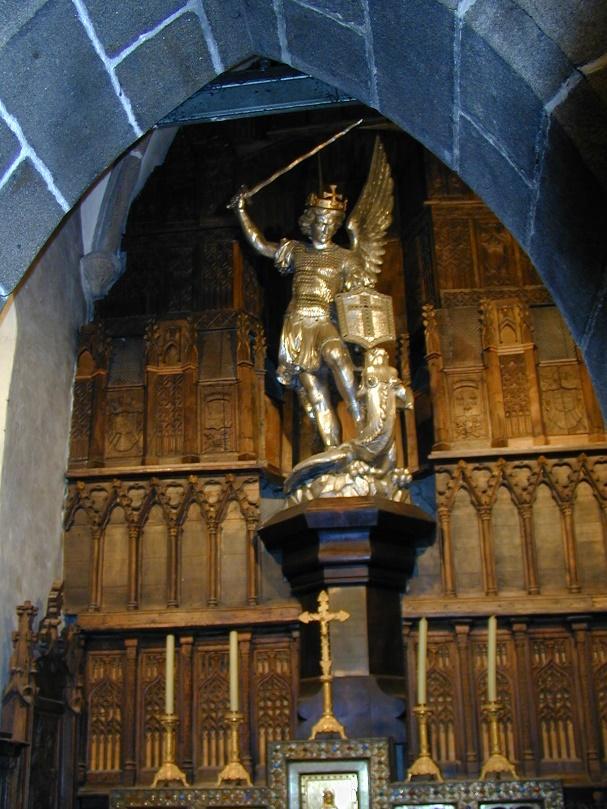
The sanctuary was finished and dedicated as Mont Saint Michel on October 16, 709 A.D. The Feast of St. Michael on October 16th commemorates the apparitions of St. Michael to Bishop Aubert and for centuries this place has been the site of numerous healings, deliverances, and pilgrimages for peasants and kings alike.

Among the immediate miracles on October 16, 709 A.D. was the healing of a woman who was blind all her life. In another, on the day of dedication, St. Michael indicated to St. Aubert where to strike a rock on the island to obtain fresh water for the entire island. In 714 A.D., St. Michael again appeared to St Aubert before letting him know that in three days he would join his parents in heaven.
St. Michael’s intercession and protection at Mont Saint Michel spread across Europe like wildfire.
Charlemagne, who became King of the Franks in 768 A.D., King of the Lambards in 774 A.D., and the first holy Roman Emperor in 800 A.D. of all of the Western Europe, was also the protector of the papacy against the Moors and Saxons. Charlemagne made a pilgrimage with his army to Mont Saint Michel, and he chose St. Michael as protector of his empire. He consecrated himself and his entire kingdom to St. Michael at this holy sanctuary. Charlemagne so venerated St. Michael for his intercession in battle that he worked with Pope Hadrian (772-795) to unify the Roman liturgy with the Gauls, and on the Feast of St. Michael (October 16th), Charlemagne with the help of Pope Hadrian composed the following mass preface,
“It is proper…that on this day we proclaim the merits of St. Michael the Archangel. For however much we are to venerate all the angels who stand in the presence of your Majesty, it is proper that in this celestial order the warrior angel deserves the first rank.”

He also helped compose, under the Pope’s guidance, a “Sequentia de Sancto Michaeli” which said that St. Michael was the commander of the heavenly hosts, intercessor before God, and vanquisher of the dragon at the end of time. He ordered an image of St. Michael with the title “Patron and Prince of the Empire of the Gaul’s,” and he forbade the veneration of unknown angels in all of his Christian kingdom.

Charlemagne gave St. Michael total primacy through this shrine and feast of October 16th over the cultural, social, and imperial ambitions of his Christian kingdom. The kings that followed Charlemagne, up until Charles XI, all made pilgrimages to Mont Saint Michel on October 16th asking that St. Michael keep all great evil in check during this era of holy Christian kings and queens.

Miracles at Mont Saint Michel have continued through the centuries. ln 1423 during an English invasion, St Michael himself intervened with a miraculous storm crashing all the ships of the enemy against the rocks. The battle between St. Michael and the dragon continues today. The dragon tempts us in our pride and ego to be the god of our own lives, saying in effect,
“I will ascend to the heavens; I will raise my throne above the stars of God. I will sit on the mount of assembly, in the far reaches of the north. I will ascend above the tops of the clouds; I will make myself like the
Is. 14:12-14Most High .”
St. Michael the Archangel defends every human soul from the temptation to be our own savior, by crying out against the dragon in our defense,
“Who is like the Lord, Our God, who has risen on high to His throne yet stoops from the heights to look down, to look down upon heaven and earth?”
Ps. 113:5-6

This coming October 16, 2018, on this feast that once ruled over the empire of a King, celebrate and commemorate the apparitions of St. Michael to St. Aubert by attending or offering a special mass in his honor. Be like King Charlemagne who invoked St. Michael to permeate every aspect of his life and kingdom. Through our own devotion and consecration, may we collaborate with St. Michael to take back our Church, our country, state, city, and even our very homes from the one who prowls around the world seeking the ruin of souls. Saint Michael the Archangel Ora Pro Nobis!
Special Mass on the Feast of St. Michael the Archangel of Mont Saint Michel on Tuesday, October 16th at 12 noon at Saint Mary Cathedral, Austin Texas


Great article. What a great heavenly warrior we have in St. Michael. I was wondering a few weeks ago if my prayers to St. Michael were time well spent. The following day, I was in Sunday Mass and a child started screaming during the homily. No one could hear the preaching, and this sense of disorder seemed to take over. I sensed a kind of helplessness in the congregation, whose efforts to follow the homily were completely overwhelmed. I said, “Michael, help us.” Immediately, the screaming stopped, and everyone could hear again. Order returned to the liturgy. Needless to say, my doubts were dispelled. Your articles in this series have been very encouraging to me, and I have shared them with others.
What is the 1st. Commandment from God?
I am the Lord your God, who brought you out of the land of Egypt, out of the house of slavery. “You shall have no other gods before me. “You shall not make for yourself a carved image, or any likeness of anything that is in heaven above, or that is in the earth beneath, or that is in the water under the earth. You shall not bow down to them or serve them, for I the Lord your God am a jealous God, visiting the iniquity of the fathers on the children to the third and the fourth generation of those who hate me, but showing steadfast love to thousands[b] of those who love me and keep my commandments.
Does this not clearly violate this 1st commandment?
Paul wrote;
But even if we or an angel from heaven should preach to you a gospel contrary to the one we preached to you, let him be accursed. As we have said before, so now I say again: If anyone is preaching to you a gospel contrary to the one you received, let him be accursed.
Can a message from heaven be real if it violates a commandment of God, thus violate the true Gospel of God.
Your translation is wrong. It is “craven” not “carved.” Craven is dead. The people alive in Heaven are not dead. They are alive in Christ. There were carved angels on the Ark of the Covenant. Right after getting the Ten Commandments. So, if they carved reminders of what Heaven offers then we can. They did not have cameras for centuries, statues are a way of having a photograph of someone we love. They are not “gods.” Is this enough of an explanation?
I’m sorry but that’s not quit accurate. In the original Hebrew the word is PSHL, it is literally translated into Carving or sculpture, not craven. Anything that is carved by hand. Besides The Cherubim are alive in heaven, but they are not worshiped, exalted, honored, venerated or praised. Only God gets all of that.To build anything to honor anything But God is idolatry.
Rev 22:8-9 I, John, am the one who heard and saw these things. And when I had heard and seen them, I fell down to worship at the feet of the angel who had been showing them to me. But he said to me, “Don’t do that! I am a fellow servant with you and with your fellow prophets and with all who keep the words of this scroll. Worship God!”
Dear Daniel, Do you have a picture of your girlfriend, wife, children, father, mother, or family in your wallet or at home? Do you have pictures of prophets and kings in your bible? Do you put up a nativity scene at Christmas? Can we also apply the same rule to you?
Here is an very good explanation (link below), “David gave Solomon the plan “for the altar of incense made of refined gold, and its weight; also his plan for the golden chariot of the cherubim that spread their wings and covered the ark of the covenant of the Lord. All this he made clear by the writing of the hand of the Lord concerning it all, all the work to be done according to the plan” (1 Chr. 28:18–19). David’s plan for the temple, which the biblical author tells us was “by the writing of the hand of the Lord concerning it all,” included statues of angels.
Similarly Ezekiel 41:17–18 describes graven (carved) images in the idealized temple he was shown in a vision, for he writes, “On the walls round about in the inner room and [on] the nave were carved likenesses of cherubim.”
The Religious Uses of Images
During a plague of serpents sent to punish the Israelites during the exodus, God told Moses to “make [a statue of] a fiery serpent, and set it on a pole; and every one who is bitten, when he sees it shall live. So Moses made a bronze serpent, and set it on a pole; and if a serpent bit any man, he would look at the bronze serpent and live” (Num. 21:8–9).
One had to look at the bronze statue of the serpent to be healed, which shows that statues could be used ritually, not merely as religious decorations.
Catholics use statues, paintings, and other artistic devices to recall the person or thing depicted. Just as it helps to remember one’s mother by looking at her photograph, so it helps to recall the example of the saints by looking at pictures of them. Catholics also use statues as teaching tools. In the early Church they were especially useful for the instruction of the illiterate. Many Protestants have pictures of Jesus and other Bible pictures in Sunday school for teaching children. Catholics also use statues to commemorate certain people and events, much as Protestant churches have three-dimensional nativity scenes at Christmas.
If one measured Protestants by the same rule, then by using these “graven” images, they would be practicing the “idolatry” of which they accuse Catholics. But there’s no idolatry going on in these situations. God forbids the worship of images as gods, but he doesn’t ban the making of images. If he had, religious movies, videos, photographs, paintings, and all similar things would be banned. But, as the case of the bronze serpent shows, God does not even forbid the ritual use of religious images.
It is when people begin to adore a statue as a god that the Lord becomes angry. Thus when people did start to worship the bronze serpent as a snake-god (whom they named “Nehushtan”), the righteous king Hezekiah had it destroyed (2 Kgs. 18:4).
What About Bowing?
Sometimes anti-Catholics cite Deuteronomy 5:9, where God said concerning idols, “You shall not bow down to them.” Since many Catholics sometimes bow or kneel in front of statues of Jesus and the saints, anti-Catholics confuse the legitimate veneration of a sacred image with the sin of idolatry.
Though bowing can be used as a posture in worship, not all bowing is worship. In Japan, people show respect by bowing in greeting (the equivalent of the Western handshake). Similarly, a person can kneel before a king without worshipping him as a god. In the same way, a Catholic who may kneel in front of a statue while praying isn’t worshipping the statue or even praying to it, any more than the Protestant who kneels with a Bible in his hands when praying is worshipping the Bible or praying to it.”
To learn more about the Catholic Faith:
https://www.catholic.com/tract/do-catholics-worship-statues
How did they get the statue of St. Michael on the top of that steeple?
Tabitha great question! This is how they took it off to repair it.
it:https://www.youtube.com/watch?v=z7wdLf_otR0
Here is how they put it back but who know how they did it in the 8th century:
I have pictures in my wallet to remind me of people I love, not God. I don’t pray to them, I don’t worship them. So what is greater, The Saint’s or Christ. The serpent on a stick or the Christ? All of that was for us to point us to Christ. “Son of Man be lifted up to draw all men unto Him”. Or Mary or Christ. Christ is supreme over all these. Catholics don’t just look at relics that’s a lie. I grew up with a father who was devoutly Catholic, I’ve worked for Catholic institutions where I had direct contact with nuns and priests. They are prayed to and venerated. I was flatly told over and over again we “worship” and pray to Mary. Jesus said when you pray you pray our Father who art in heaven. IN Rev. in heaven only Jesus is worthy of all honor, glory and praise. He is the only one who is venerated, no one else. Everything in the old Test. points to Christ. who is greater. Why do I need an earthy priest when Jesus is my high priest; For we do not have a high priest who is unable to sympathize with our weaknesses, but one who in every respect has been tempted as we are, yet without sin. Let us then with confidence draw near to the throne of grace, that we may receive mercy and find grace to help in time of need. Who is greater to go to in a time of need? Mary, a saint? Why not go directly to the source of our salvation, hope and power, the Father in Christ’s name. Everything from Gen to Rev point to Christ who is above all things.
It’s Catholic Doctrine that the stories in the the Pentateuch like Adam and Eve are not real people they are stories to teach us moral truth. If there was no Adam and eve as depicted in the Bible, there is no fall, if there is no fall there is no need for redemption for the cross.
Are you saying that Archangel Gabriel was worshiping Mary when he said “Hail Mary” as recorded in scripture? Or when asking her to pray for us–is that worshiping her, or asking her assistance as she was the one who convinced the Lord to perform His first public miracle at the marriage at Cana?
Thanks for the history of Mont St Michel. I never knew it.