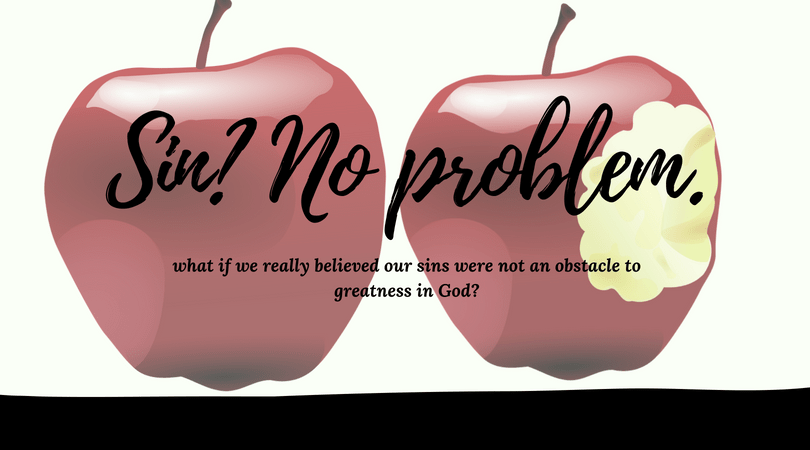
(Created by me on canva.com with free images)
Sin? No problem.
This Sunday we heard the Gospel reading on the Fall, of the moment sin entered creation and divided all that was meant to be united. Since then the human person has been faced with the conditions of inner division and brokenness as a personal reality and as a reality in creation. Yet, since the coming of Christ, and His redeeming total gift of self in love on the Cross, sin has not been a problem for those seeking holiness in a full relationship to God and fellow man.
What on earth do I mean by that?
What I mean is that for grace, sin isn’t a problem. And neither are human limitations a problem for grace.
How often do we encounter- in ourselves, our friends and family, society- this spirit of negativity and gloom that sounds like this: Because of this or that failing, or this or that limitation, I can’t…or there’s no way…or such and such is impossible.
For example- If I didn’t get angry so often, I could really be a holy person. Or if I wasn’t so (insert negative characteristic here), I could love people better. Or if I didn’t have to struggle with such and such vice, then I could be someone others really look up to. We act as if our sins and failings make us unworthy of the task God has given us, or incapable of leading those entrusted to our care, or not able to fulfill our personal missions.
We act as if, because of our short comings and sins, that we are not enough. And worse still, in darker moments we allow these short comings to be become our excuses for not trying, for not living out our personal callings…as if only “other” more perfect holy people were capable of answering Christ’s universal call to holiness.
So, did God give us a rigged deck, or what?
Yesterday we also heard the Proto-gospel, the foreshadowing of the coming of Christ through Mary, and the coming victory over the devil:
I will put enmity between you and the woman,
and between your offspring and hers;
They will strike at your head,
while you strike at their heel. (Gen 3:15)
God told Eve that the devil would strike at the heels of her descendants – that’s us. So we can take it for granted that we have been struck at the heel, so to speak. Struck at the heel, yes – but doomed? Definitely not. This passage is called the proto-gospel because it is thought to be the first sliver of light of salvation coming, wherein God promises to send the Messiah (see footnote explaining proto-gospel).
What does it change if we take for granted that we have been “struck at the heel?” Well, what if our current human conditions of limitation and sin were not considered an obstacle to true greatness? And rather than an obstacle, what if they were taken for granted as the perfect conditions for God to achieve such greatness in us? Or did Christ come and conquer sin, or did he not?
What if the problem was not our limitations, but our incessant obsession with perfectionism from a moral perspective? What if the problem wasn’t our sin, but thinking we first have to be sinless before presenting our needs to Christ for His grace?
The game-changer…
If we take for granted that we are limited and that we carry within ourselves a tendency to sin, then we waste less time fretting about them, ignoring them, repressing them, etc, and more time directly dealing with our weaknesses honestly before God and allowing His saving grace to transform us.
When we freely and humbly acknowledge our short-comings and sins to God (and to ourselves), than those conditions become not an obstacle, but rather in His mercy become a trampoline with which we can reach the heights of the freedom and love and originality of the children of God. After all, every single saint and Saint was also a sinner. And each of us is called, according to our state in life, to reach the heights of holiness meant for us.
But we won’t reach it alone, and we won’t reach it by thinking we need to be perfect beforehand. We definitely won’t make it if we refuse to admit that our weaknesses exist. We’ll reach it through embracing our limitations in humility and freedom, and following His lead in developing a deep love relationship with God and fellowman – with smallness and sin as the starting place.
Further reflection:
I’ll leave you with a few paragraphs to mull over, in the event that the above struck a chord for you:
The most valuable means for us to grow up towards God is our misery and weakness. That person is great who is able to repeat these words: God loves me because of my faults; because I am small, not although I am small. (…)
You see, because we are small, not just although we are small – because we are small. I have to acknowledge my helplessness, while at the same time my dependence and love also need to be acknowledged. That is the meaning of the whole process.
If I manage to put this vital process into practice, I will gradually be able to say “because I am small”. Then my smallness, my faultiness and sinfulness – not in themselves, but against the background of the open weakness of my nature – are the most essential title and right I possess to expect God’s mercy.
Please understand, this is what the piety of people today should be like. The people of today, including ourselves, are called to holiness.
– Fr. Joseph Kentenich* (emphasis mine)
* Fr. Joseph Kentenich is the Founder of the Schoenstatt Movement


Leave a Reply